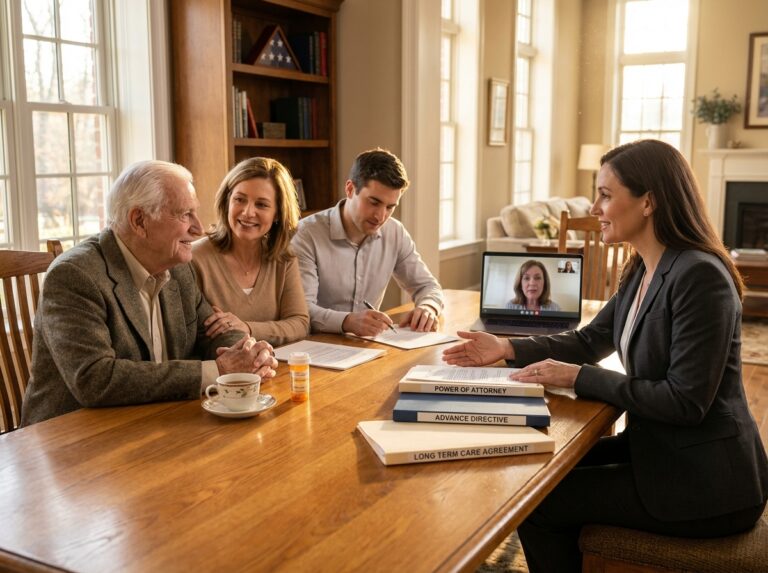
Family caregivers often manage complex legal and financial matters while supporting loved ones. This article walks through creating a legal-document checklist, step-by-step guidance for replacing lost Social Security cards and property deeds, answers to common caregiver questions, and practical next steps to protect and organize vital records.
How to Build a Legal Document Checklist for Family Caregivers
When a critical document is missing, the feeling can range from mild annoyance to outright panic. As a caregiver, you don’t have time for either. Your focus is on getting what you need to manage your loved one’s affairs efficiently. This guide provides a direct, step-by-step process for replacing two of the most essential documents: a Social Security card and a property deed.
Replacing a Lost Social Security Card
The Social Security Administration (SSA) has a clear process for replacing a lost, stolen, or damaged card. The good news is that replacement cards are always free.
Step 1: Gather Your Documents
The SSA requires you to prove your identity and, in some cases, your U.S. citizenship or lawful non-citizen status. You will need original documents or certified copies; photocopies and notarized copies are not accepted.
- For U.S. Citizens: You need to provide one primary identity document. Acceptable documents include a U.S. driver’s license, a state-issued non-driver ID card, or a U.S. passport. If you don’t have one of these, the SSA may accept other documents like an employee ID card or health insurance card, but you will need to provide additional proof of identity. If you were born outside the U.S., you must also provide proof of citizenship, such as a U.S. birth certificate, Certificate of Naturalization, or Consular Report of Birth Abroad.
- For Non-Citizens: You must show your current, unexpired immigration documents. This could be a Form I-551 (Green Card), an I-94 (Arrival/Departure Record) with your unexpired foreign passport, or an I-766 (Employment Authorization Document/EAD).
Step 2: Complete Form SS-5
The official application is the Form SS-5, Application for a Social Security Card. You can download it directly from the SSA website, fill it out, and print it.
Step 3: Submit Your Application
You have three options for submitting your application and documents.
- Online: For many U.S. citizens age 18 or older with a valid state-issued ID from a participating state, the fastest way is through a my Social Security account on the SSA website. This is only for a replacement card with no changes, like a name change.
- In Person: If you are not eligible to apply online or are applying on behalf of someone else, you will likely need to visit a local SSA office. It is highly recommended to call ahead for an appointment. You can find your nearest office using the SSA Field Office Locator.
- By Mail: You can mail your completed Form SS-5 and original documents to your local SSA office. However, sending important original documents like a passport through the mail carries risk. If you choose this route, use a trackable mail service.
Expect the new card to arrive by mail in about 10-14 business days. The SSA does not issue temporary cards.
Checklist: What to Bring to the SSA Office
- Completed and signed Form SS-5.
- Original proof of identity (e.g., valid driver’s license or passport).
- Original proof of citizenship or immigration status, if needed.
- If applying for someone else, bring proof of your own identity plus documentation of your authority (see below).
Special Considerations for Caregivers
If the Person is Incapacitated:
If your loved one cannot handle their own affairs, you may be able to apply on their behalf, but the process is specific. The SSA does not typically recognize a durable power of attorney (POA) for the purpose of requesting a replacement card. Instead, the SSA has its own official process for appointing a “Representative Payee” to manage another person’s benefits. A court-appointed legal guardian can also apply for a replacement card. In either case, you must provide proof of your official appointment along with your own identification.
If the Person is Deceased:
You cannot get a replacement Social Security card for a deceased person. Instead, you will need to report the death to the SSA. The funeral home usually does this, but you should confirm. You will need a certified copy of the death certificate to apply for any survivor benefits you may be entitled to.
Obtaining a Certified Copy of a Property Deed
Unlike a Social Security card, property deeds are public records managed at the county level. You are not replacing a lost original but rather obtaining an official, certified copy of the deed that is on file with the government.
Step 1: Identify the Correct County Office
Deeds are recorded in the county where the property is located. You need to find the office of the County Recorder, Registrar of Deeds, or County Clerk. A quick online search for “[County Name] [State] recorder of deeds” will usually point you in the right direction. To locate the specific deed, you will need information like:
- The property’s full street address.
- The owner’s full legal name as it would have appeared on the deed.
- The Parcel Number or Tax ID number (this is often the most accurate way to search and can be found on a property tax bill).
Step 2: Search for the Deed and Request a Copy
Many counties now have online databases where you can search for recorded documents. Some allow you to view an unofficial copy for free and order a certified copy online for a fee. If online services aren’t available, you will need to visit the office in person or submit a request by mail. Fees for certified copies are typically charged per page, plus a certification fee, often totaling $10 to $30 per document. Turnaround time can be immediate if in person or take several days to weeks for mailed requests.
Checklist: What to Bring to the County Recorder’s Office
- Your government-issued photo ID.
- All known property information (owner name, address, parcel number).
- Payment for fees (check their website for accepted forms of payment).
- If acting for someone else, an original or certified copy of your durable power of attorney or guardianship papers.
Using a Power of Attorney:
If you are acting on behalf of the property owner, you can use a durable power of attorney to request copies or sign real estate documents. The POA must grant you specific authority over real estate transactions. You will likely need to present the original or a certified copy of the POA document along with your own photo ID.
When Records are Damaged or Missing
In rare cases, like a courthouse fire, public records can be lost. If you cannot find the deed through the county, here are the next steps:
- Contact the Title Company: The title insurance company that handled the property’s last sale or refinance may have a copy of the deed in their files.
- File an Affidavit of Lost Deed: This is a sworn legal statement you sign in front of a notary, detailing the known facts about the lost deed (grantor, grantee, property description, approximate date). The county may accept this to help reconstruct the record.
Sample Language for an Affidavit of Lost Deed:

I, [Your Name], being duly sworn, state that I am the [attorney-in-fact for/child of/etc.] the owner of the real property located at [Property Address], legally described as [Legal Property Description]. A deed conveying this property to [Owner's Name] was executed on or about [Date] and recorded in the official records of [County Name], [State]. A diligent search for the original deed has been made, and it cannot be found and is believed to be lost or destroyed.
- Quiet Title Action: This is a lawsuit filed in court to resolve ownership disputes and clear a property’s title. It is a final step used when the chain of title is unclear and cannot be fixed through simpler means.
Red Flags: When to Involve an Attorney
While you can handle many document replacement tasks on your own, certain situations require professional legal help. Contact a real estate or estate planning attorney if you encounter:
- A dispute over property ownership or contested heirs.
- Unresolved liens or claims against the property.
- The need to file a quiet title action.
- Complexities with a deed held in a trust or a business name.
Frequently Asked Questions About Lost Documents and Legal Authority
Can I replace someone else’s Social Security card using a power of attorney?
Generally, no. The Social Security Administration (SSA) does not recognize a power of attorney (POA) for the purpose of applying for a replacement card on someone else’s behalf. The SSA has its own distinct process for individuals who need help managing their benefits, which is to appoint a “Representative Payee.” While a valid POA is crucial for managing many other financial and legal affairs, the SSA operates under its own federal rules. Action Step: If your loved one cannot manage their own affairs, your first step should be to contact the SSA to inquire about becoming their Representative Payee. This is the officially recognized path for managing their Social Security matters.
What documents does the SSA accept to prove identity for a replacement card?
The SSA requires original documents or certified copies issued by the official agency. Photocopies or notarized copies are not accepted. For a U.S. citizen, you’ll typically need one document that proves both identity and citizenship. A U.S. passport is ideal as it does both. Otherwise, you’ll need a combination, such as a state driver’s license or ID card to prove identity, plus a U.S. birth certificate to prove citizenship. For noncitizens, current immigration documents, like a Form I-551 (Green Card) or an I-94 Arrival/Departure Record, are required. Action Step: Before you apply, visit the SSA website to see the full list of acceptable documents. This list can change, and having the wrong documents is the most common reason for application delays.
How long does a replacement Social Security card take to arrive, and is there a fee?
There is no fee to replace a Social Security card. The SSA provides this service for free. After your application is successfully submitted and processed, you can expect the new card to arrive by mail within 10 to 14 business days. Action Step: If you don’t receive the card within that timeframe, follow up with the SSA office where you applied or call their national number at 1-800-772-1213. Keep a record of when and how you applied.
What if the person is deceased? Can I get a replacement Social Security card for them?
No, the SSA will not issue a replacement card for a deceased person. Once a person has passed away, their Social Security number is retired. Your focus as a caregiver or family member should shift from replacing the card to properly notifying the SSA of the death. This is a critical step to stop benefit payments and to determine if any survivor benefits are available for a spouse or dependent children. Action Step: The funeral home will often report the death to the SSA. However, you should verify this has been done. You will need a certified copy of the death certificate to handle any final matters with the SSA, including applying for survivor benefits.
How can I get a certified copy of a property deed?
You can obtain a certified copy of a deed from the county recorder’s office, sometimes called the registrar of deeds or county clerk, in the county where the property is located. Most counties now have online databases where you can search for the document using the property address, the owner’s name, or the parcel identification number (PIN). You can often order a certified copy directly from the website for a fee. Alternatively, you can visit the office in person or request a copy by mail. Action Step: Find the correct county office online and review their specific instructions for requesting copies. Note the fees and required identification. Fees typically range from $10 to $30 per document.
What if the county records were destroyed, for example, in a fire?
While rare, this is a serious situation that requires professional help. If official records are gone, you cannot simply get a certified copy. The process of re-establishing ownership is called “reconstructing title.” This may involve finding copies of the deed from other sources, such as the title company that handled the closing, the mortgage lender, or state archives. It might also require filing an “affidavit of lost deed” or, in complex cases, a legal action known as a “quiet title suit” to get a court to legally declare ownership. When to Consult an Attorney: This is not a DIY project. If you discover public records are missing or destroyed, contact a qualified real estate attorney immediately.
Can a power of attorney be used to sign a new deed or be recorded?
Yes, an agent acting under a durable power of attorney can sign a deed on behalf of the principal, but only if the POA document explicitly grants the authority to conduct real estate transactions. Vague language is not enough; it must be specific. Furthermore, when the new deed is recorded, the county recorder will almost always require that the original or a certified copy of the POA be recorded along with it to prove the agent’s authority. Action Step: Review the POA document carefully to ensure it contains the necessary powers. If you are unsure, have an attorney review it before attempting any real estate transaction.
What’s the difference between a certified copy of a deed and the original?
The “original” deed is the physical document that was signed by the buyer and seller at the property closing. After signing, that original is sent to the county recorder to be entered into the public record. The county then returns the original to the new owner. A “certified copy” is a duplicate of the image on file with the county, which includes an official stamp or seal from the recorder’s office certifying that it is a true and correct copy of the public record. For nearly all legal and financial purposes, including selling a property or proving ownership, a certified copy is just as valid as the original.
When is guardianship required instead of using a durable power of attorney?
The key difference is timing and capacity. A durable power of attorney is a document that a person signs *while they still have the mental capacity* to understand it, granting an agent the power to act on their behalf. Guardianship (or conservatorship in some states) is a court-supervised legal process that is initiated *after a person has lost capacity* and can no longer make decisions for themselves. You would need to petition for guardianship if your loved one is already incapacitated and never signed a durable POA, or if the POA they signed is invalid or doesn’t grant the specific authority you need. When to Consult an Attorney: If you believe your loved one can no longer make their own decisions and there is no POA in place, you must speak with an elder law attorney to begin guardianship proceedings. It is a formal court process that requires legal guidance.
How do I prevent identity theft when important documents are missing?
You need to act quickly. First, place a fraud alert with one of the three major credit bureaus (Equifax, Experian, or TransUnion). The one you contact is required to notify the other two. A fraud alert makes it harder for someone to open new credit in the person’s name. For even stronger protection, consider a credit freeze, which locks access to their credit report entirely. Action Step: Immediately place a fraud alert online. It’s free and lasts for one year. Also, monitor all bank and credit card statements for any unusual activity and report it immediately.
What immediate steps should I take if I discover important documents are lost?
- Inventory and Secure: First, determine exactly what is missing. Make a list. Secure any other important documents you do have in a safe place.
- Notify Financial Institutions: If bank cards, checkbooks, or financial statements are missing, contact the bank or financial institution immediately to report the loss and protect the accounts.
- Report to Agencies: If a driver’s license is lost, contact the state DMV. If a Social Security card is lost, prepare to contact the SSA.
- Place Fraud Alerts: If any document contains a Social Security number or other sensitive personal data, place a fraud alert with the credit bureaus as a precaution.
Where can I find reliable help for these issues?
You are not alone in this process. For specific document replacement, go directly to the source. The Social Security Administration website and your local county recorder’s office are the most authoritative sources for their respective documents. For legal questions about your authority to act, such as interpreting a POA or pursuing guardianship, you need professional legal advice. Your state’s bar association can provide a referral service for qualified attorneys. The National Academy of Elder Law Attorneys (NAELA) is an excellent resource for finding a lawyer who specializes in these exact issues.
Final Steps and Practical Next Actions for Caregivers
Navigating the maze of documents and legal authority can feel overwhelming. Now it is time to turn that knowledge into a concrete plan. This is your roadmap for moving forward, designed to bring order to the chaos and empower you to act confidently. Think of it not as a list of chores, but as a series of protective steps for both you and your loved one.
Your Prioritized Action Plan
Focus on what needs to be done right now, then move to tasks that build a secure foundation for the future.
- Immediate Actions (The Next 72 Hours)
- Secure Identity and Financial Access. If a Social Security card, driver’s license, or wallet is missing, place a fraud alert with the three major credit bureaus (Equifax, Experian, TransUnion). A credit freeze offers even stronger protection. This is a critical first step to prevent identity theft.
- Notify Key Institutions. Contact banks, credit card companies, and the Social Security Administration to report the missing documents. For the SSA, you can call their national number at 1-800-772-1213. Document who you spoke to, the date, and what they advised.
- Order Certified Copies. Begin the process of replacing essential records. If there has been a death, order at least 6-10 certified copies of the death certificate from the state or county vital records office. You will need them for almost every administrative task. For property, start the request for a certified copy of the deed from the county recorder’s office.
- Short-Term Goals (The Next 1-3 Months)
- Establish Legal Authority. If they do not already exist, work with your loved one to create a durable power of attorney (POA) for finances and a healthcare power of attorney with an advance directive (living will). These documents are the cornerstones of your ability to act on their behalf if they become incapacitated.
- Obtain and Store Property Records. Once you receive the certified copy of the deed, make several photocopies and digital scans. Confirm that the property title is clear of unexpected liens by reviewing the document carefully.
- Confirm Beneficiaries. Gather and review beneficiary designation forms for all life insurance policies, retirement accounts (IRAs, 401(k)s), and bank accounts with payable-on-death (POD) or transfer-on-death (TOD) designations. These designations override a will, so ensuring they are up-to-date is vital.
- Long-Term Strategy (Ongoing)
- Conduct an Annual Review. Once a year, sit down and review all legal documents. Check that the named agents in POAs are still willing and able to serve. Ensure contact information is current.
- Update as Life Changes. Major life events like a marriage, divorce, or the death of a named agent or beneficiary require an immediate update to your legal documents. Do not let these documents become outdated.
- Plan for Long-Term Care. If it is relevant to your situation, begin researching Medicaid rules and long-term care planning. The financial requirements, including asset look-back periods, are complex. Consulting an elder law attorney early can prevent costly mistakes down the road.
Essential Contacts and Records Template
Use this template to create a master contact sheet. Keep a physical copy in your legal file and a secure digital version.
Key Contacts List

Social Security Administration (SSA)
Local Office Address: [Find using the SSA Office Locator]
Office Phone:
National Phone: 1-800-772-1213
Online Account Info: [my Social Security username/password location]

County Recorder / Registrar of Deeds
County Name:
Office Address:
Phone:
Website for Online Records:

Primary Care Physician
Name:
Office Address:
Phone:
Patient Portal Info:

Elder Law Attorney
Name / Firm:
Address:
Phone:
Email:

Probate Court (if applicable)
County:
Address:
Clerk's Phone Number:
Estate Case Number:
Record Storage and Prevention
Secure Storage Practices
How you store documents is as important as having them. Originals of wills, trusts, and POAs should be kept in a secure, accessible location.
- Fireproof Safe at Home. Excellent for quick access to documents like POAs and advance directives that you might need in an emergency.
- Safe Deposit Box. A good option for documents you will not need urgently, like original property deeds or stock certificates. Be aware that access can be restricted immediately following the owner’s death until an executor is legally appointed, so avoid storing an original will there if it is the only copy.
- Encrypted Digital Backup. Scan every important document and save it to a secure, encrypted cloud service with two-factor authentication. This creates a redundant, accessible backup you can access from anywhere.
Preventing Future Losses
A little planning can prevent a future crisis.
- Digitize Everything. Make a habit of scanning new documents as they arrive.
- Use Certified Copies. Never give away your only original document unless absolutely required. Use certified copies whenever possible.
- Limit Who Carries Originals. Your loved one should not carry their Social Security card or other irreplaceable documents in their wallet. A photocopy or a state-issued ID card is sufficient for most daily purposes.
When to Hire a Professional
Knowing your limits is a strength. Certain situations require specialized expertise.
- Title Attorney or Real Estate Lawyer. Hire one if you discover the property deed is missing entirely, there are unresolved liens, the chain of title is unclear, or there is a dispute over property boundaries or ownership.
- Elder Law Attorney. This is your go-to professional for creating and updating powers of attorney, advance directives, trusts, and wills. They are also essential for navigating the complexities of Medicaid planning and asset protection.
- Probate Lawyer. After a death, a probate lawyer guides the executor through the court-supervised process of settling an estate, paying debts, and distributing assets according to the will.
You have taken on a difficult but essential role. By approaching these tasks systematically, you are not just organizing paperwork; you are creating a shield against future legal friction, financial confusion, and emotional stress. Treat this process like a project. Document every phone call, every email, and every transaction in a simple log. This paper trail creates transparency and protects both you and the person you care for. Taking these deliberate steps now is an act of profound care that will bring peace of mind for years to come.
Sources
- Contact Social Security By Phone | SSA — You can call us at 1-800-772-1213 between 8:00 am – 7:00 pm local time, Monday through Friday.
- Field Office Locator | SSA – Social Security — Looking for a local office? Use one of our online services and save yourself a trip!
- The United States Social Security Administration — Official website for the U.S. Social Security Administration.